
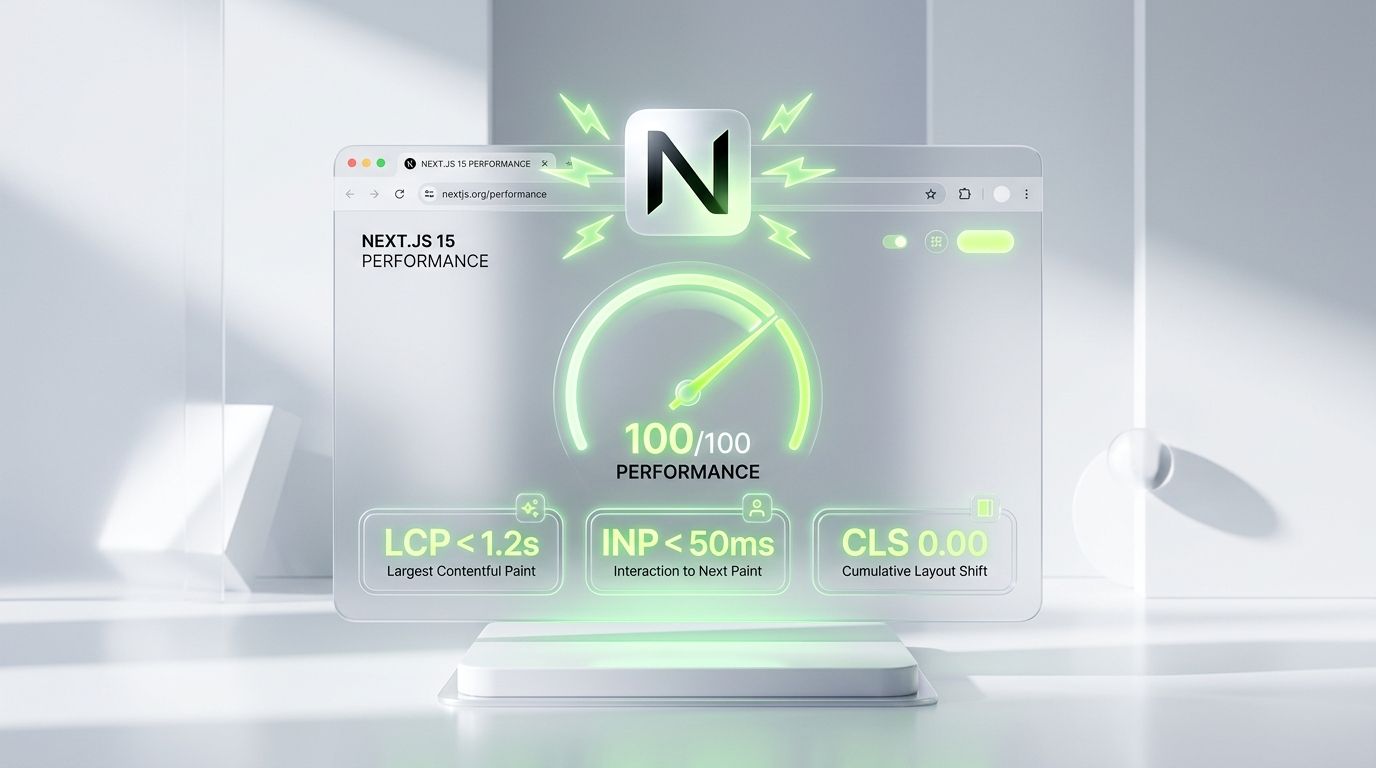
Next.js 15+ has become the premier React framework for technical SEO and web development, enabling sub-second page loads, server-side rendered HTML for search engine crawlers, and perfect 95+ Core Web Vitals scores when architected correctly.
Why Next.js Outperforms Traditional CMS for SEO
In 2026, page experience is an explicit Google ranking factor. When potential clients visit your website, every 100ms of delay erodes conversion rates:
- 1Server Components by Default: In the Next.js App Router, components render on the edge server by default. Zero unnecessary client-side JavaScript is shipped to the visitor's browser.
- 2Instant Pre-rendering for AI Crawlers: Search crawlers (Googlebot, Bingbot, GPTBot, ClaudeBot) receive fully rendered content with zero hydration delay.
- 3Automatic Asset Optimization: Built-in
next/imageandnext/fonteliminate Cumulative Layout Shift (CLS) and convert assets into modern.avifand.webpformats automatically.
Businesses migrating from legacy platforms to custom Next.js web development regularly see a 40–70% reduction in bounce rate and immediate ranking improvements.
Core Web Vitals Optimization Architecture
Google's Core Web Vitals evaluate three real-world user experience metrics:
                    ┌───────────────────────────────┐
                    │  Google Core Web Vitals 2026  │
                    └───────────────┬───────────────┘
                                    │
        ┌───────────────────────────┼───────────────────────────┐
        ▼                           ▼                           ▼
  1. LCP (< 1.8s)             2. INP (< 150ms)            3. CLS (< 0.05)
  Largest Contentful Paint    Interaction to Next Paint   Cumulative Layout Shift
  - Hero image preloading     - Edge server rendering     - Explicit width & height
  - Server-side rendering     - Minimal JS bundle size    - Font-display: swap
1. Largest Contentful Paint (LCP) < 1.8s
LCP measures how fast the main visual content renders on screen. To ensure sub-second LCP:
- Preload critical hero images using
priorityonnext/image. - Serve assets from an ultra-fast Content Delivery Network (CDN) like ImageKit or Cloudflare.
- Avoid render-blocking external third-party CSS or heavy tracking scripts.
2. Interaction to Next Paint (INP) < 150ms
Replacing First Input Delay (FID), INP evaluates the responsiveness of user clicks, form submissions, and menu toggles:
- Offload non-essential analytics tracking using Web Workers or
next/scriptwithstrategy="afterInteractive". - Keep React Client Components small, localized, and separated from static server layouts.
3. Cumulative Layout Shift (CLS) < 0.05
CLS measures visual stability as assets load:
- Always define explicit aspect ratios or dimensions on image containers.
- Host web fonts locally via
next/font/googlewithdisplay: swapto eliminate Flash of Invisible Text (FOIT).
Dynamic Metadata & JSON-LD Schema in Next.js
Modern technical SEO requires dynamic, page-specific metadata. Here is the exact pattern implemented across our production client websites:
export async function generateMetadata({ params }) {
  const { slug } = await params;
return {
title: ${project.title} | Ayush Jha,
description: project.excerpt,
alternates: {
canonical: https://www.ayushjha.site/works/${project.slug},
},
openGraph: {
title: project.title,
description: project.excerpt,
images: [{ url: project.ogImage, width: 1200, height: 630 }],
},
};
}
```
Step-by-Step Next.js SEO Deployment Checklist
Follow this checklist for every production deployment:
- 1Semantic HTML5: Ensure a single
<h1>per route with proper nested<h2>and<h3>tags. - 2Dynamic XML Sitemap: Implement
src/app/sitemap.jsto dynamically generate valid XML entries with real milestone timestamps. - 3Strict Robots Directives: Configure
src/app/robots.jsallowing all certified crawlers while protecting internal administrative endpoints. - 4Structured Schema Graphs: Embed
Organization,Person, andLocalBusinessJSON-LD markup on core pages. - 5Ongoing Performance Retainers: Regular dependency audits, Next.js framework upgrades, and uptime checks via website maintenance services.
Frequently Asked Questions
Why choose Next.js over WordPress for small business websites?
WordPress sites typically rely on 20+ third-party plugins that bloat code, slow down mobile load times, and create security vulnerabilities. Next.js produces clean, compiled, ultra-secure static and server-rendered HTML that loads in under 1 second.
How much does a custom Next.js website cost in Delhi NCR?
A custom Next.js business website typically ranges from ₹8,000 to ₹14,000 for standard 5–8 page business platforms with custom design, mobile responsiveness, and built-in technical SEO. Check our transparent pricing packages for detailed inclusions.
Does Next.js guarantee #1 Google rankings?
No framework alone guarantees #1 rankings. Next.js provides the fastest possible technical foundation (Core Web Vitals, crawlability, and schema), which pairs with comprehensive SEO services in Delhi to earn top organic search positions.
Conclusion & Next Steps
Speed, technical integrity, and semantic clarity are the true competitive advantages in modern search. Building your digital presence on Next.js ensures your website stays fast, secure, and ready for both search engines and generative AI answer platforms.
Ready to upgrade your website to a blazing fast Next.js architecture? Explore our complete Web Development services or reach out directly to Ayush Jha today.